
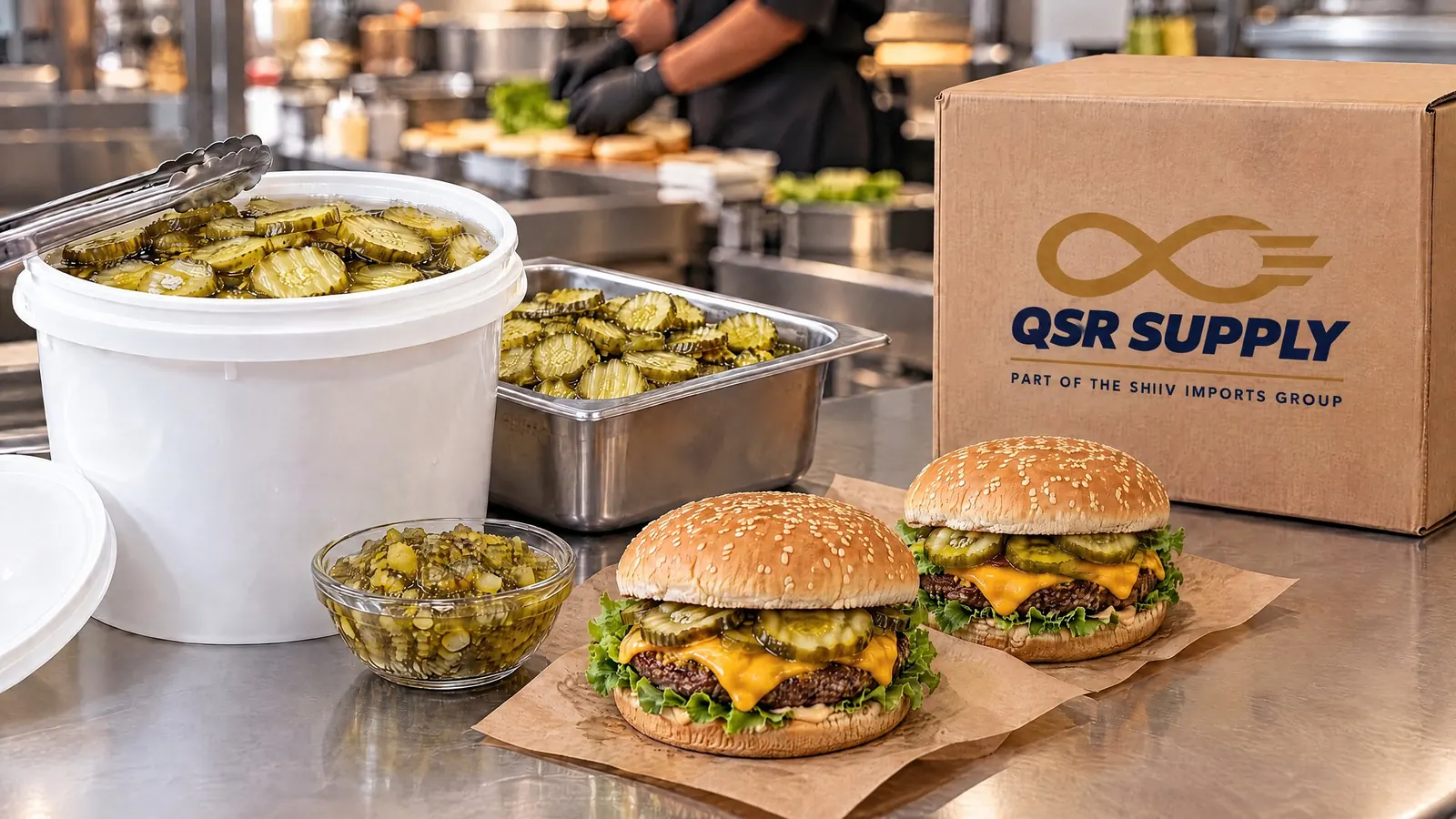
Why the humble pickle deserves a proper spec
A pickle slice is a small component with a big job. It adds acid and crunch that cut through fat in a burger, and guests notice when it changes. A slice that is too thin goes limp under a hot patty. Brine that is too sweet or too salty shifts the taste of your signature burger. Inconsistent slice counts per pail change portioning on the line.
That is why multi-site QSR operators treat pickles the same way they treat sauces and condiments: a written specification, approved samples and change control, not a generic line pulled from a catalogue.
Where the world's gherkins come from in 2026
Gherkins and cucumbers are the same species, but gherkins are grown as a separate cultivar group and picked small, usually 4 to 8 cm, for pickling. APEDA states that size range on its cucumber and gherkins page.
| Market signal | What the data shows | Source |
|---|---|---|
| India's share of global gherkin exports | About 76% in the January 2026 dashboard and about 73% in the June 2026 dashboard | APEDA monthly dashboards |
| India's 2025-26 exports | APEDA lists 314,518.69 metric tonnes, about 314,519 tonnes, worth USD 307.61 million, with volume up about 8% | APEDA; The Hindu BusinessLine |
| Where Indian gherkins went | The US was still the largest buyer, but volume was down 23% for the full year. The Indian Gherkin Exporters Association said tariffs hurt early shipments and that they later recovered. Germany, Russia, Canada and the Netherlands bought more | The Hindu BusinessLine; APEDA June 2026 dashboard |
| Turkey | Drought and irrigation limits in key growing regions, with greenhouses keeping output broadly stable | APEDA June 2026 dashboard |
| Europe | APEDA's June 2026 outlook shows higher export prices in Belgium and the Netherlands, linked to tight greenhouse supply and energy costs | APEDA June 2026 dashboard |
Indian production is concentrated in Karnataka, Tamil Nadu and Andhra Pradesh and runs on contract farming, with nearly all output exported. That export focus is useful for buyers: APEDA notes that most processing units run quality systems such as HACCP, ISO or BRC to suit importing countries. Those are factory systems. Shiiv Imports holds ISO 9001.
India ships gherkins in two main forms. Provisionally preserved stock is held in brine or vinegar in 220 litre food-grade HDPE drums and repacked by the importer. Preserved in vinegar stock is ready to eat in jars, cans or other finished packs. APEDA's June 2026 dashboard says Spain imports bulk brine-preserved gherkins from India and Turkey and re-exports them as vinegar-pickled gherkins, so the country on a finished pack is not always where the cucumbers were grown. Check origin against the documents.
How to specify a burger pickle
| Spec point | What to decide | Why it matters on the line |
|---|---|---|
| Cut | Crinkle cut or straight, slice diameter range | Crinkle cut holds sauce and grips the bun; diameter controls coverage |
| Thickness | A tolerance in millimetres | Thin slices wilt under heat; thick slices slide out of the burger |
| Brine style | Dill (sour), sweet, or bread-and-butter style | Sets the flavour profile of your build |
| Firmness | A texture target and how it is checked | Crunch is the first thing guests notice. Ask whether a firming agent is used |
| Acidity and salt | Target ranges for acidity, pH and salt | Drives taste, safety and shelf life |
| Additives | Full ingredient list with code numbers | Colours, preservatives and sulphites affect labels and allergen statements |
| Defects | Limits on broken slices, soft centres and foreign matter | Protects yield and consistency |
| Drained weight | Declared drained weight per pack | The slices, not the brine, are what the line portions |
On acidity, many processors work to a finished equilibrium pH of 4.6 or lower, the benchmark used in US acidified food rules (21 CFR Part 114). That is a US processing benchmark, not an Australian legal limit. Ask your supplier for the target and the batch results rather than assuming it.
For sauces, a chopped gherkin relish gives kitchens a consistent base for burger sauce, tartare and dressings with less prep. Specify the chop size and the drained solids so every batch of sauce sets the same way.
Australian import rules to check before you order
Biosecurity. DAFF allows preserved and pickled vegetables in salt brine, vinegar, alcohol, sugar syrup or oil. Its public guidance says they must be aseptically packaged, meaning commercially heat treated so the contents are sterile, and commercial consignments need evidence of the processing method. BICON also lists pickling in brine or vinegar as its own pathway, so bulk brined stock in drums can sit under different conditions. Check the current BICON case for the exact product and country before booking freight.
Food safety at the border. The Imported Food Inspection Scheme classifies food as risk food, surveillance food or compliance agreement food. Food that is not listed as risk food is treated as surveillance food, and DAFF refers 5% of those consignments for inspection against Australian food standards. A failed inspection means holding and delays, so clean documents and compliant labels matter.
New Zealand. Australia and New Zealand share joint food standards. DAFF says this lets most food move between the two countries without inspection under the Imported Food Inspection Scheme, except for a short list of risk foods such as beef. Biosecurity conditions can still apply. New Zealand biosecurity rules still apply to imports from other countries.
Allergens and labels: two common traps
Sulphites. Some pickled vegetables use sulphite preservatives (codes 220 to 228). Under the Food Standards Code, added sulphites at 10 mg/kg or more must be declared as "sulphites" in bold in the ingredient list and in a separate bold "Contains" statement. Ask for the actual level, not just a yes or no.
Gluten from malt vinegar. Most gherkins use spirit vinegar, but some recipes use malt vinegar, which is made from barley. Barley must be declared if it contains gluten, which matters for any menu item you describe as gluten-free.
For the full picture on allergen declarations for dressings and condiments, see our allergen labelling guide for QSR sauces and condiments.
Pack format and storage
- Foodservice pails suit high-volume burger lines and reduce opening and handling time.
- Catering jars suit lower-volume sites, delis and buffets.
- Pouches reduce packaging weight and waste, and some suit portion-controlled use.
Ambient stock is easy to store, but once opened most products should be chilled and used within the supplier's stated period. Standard 3.2.2 requires food businesses to store food in a way that protects it from contamination, and to keep potentially hazardous food at safe temperatures, so write the once-opened instructions into your store procedures.
Pickle sourcing checklist for multi-site QSR
- Write a specification covering cut, thickness, brine, firmness, acidity, salt, additives, defects and drained weight.
- Approve samples in your own stores, under a real hot patty and real holding times.
- Confirm the origin of the cucumbers and where they were finished and packed.
- Check BICON conditions for the exact product, pack and country of export.
- Get the full ingredient list with additive codes and the sulphite level, and confirm the vinegar type.
- Ask which food safety system the factory runs, and ask for recent batch results. APEDA says most Indian processing units use systems such as HACCP, ISO or BRC for export markets. That is not a claim that QSR Supplier holds those certifications. Shiiv Imports holds ISO 9001.
- Plan around seasons and weather, since irrigation pressure in Turkey and higher prices in parts of Europe show how quickly supply can tighten.
- Lock change control so the factory cannot change brine, firming agent, cut or pack without written notice and new samples.
Our take
Pickles look like a commodity, but the gap between a good and a poor burger pickle shows up on every tray. With India supplying around three quarters of global gherkin exports, and other origins under weather and cost pressure, QSR buyers who set a clear specification and work with factories that can show their quality system will get steadier crunch, flavour and supply.
QSR Supplier sources sliced and whole gherkins, gherkin relish and pickled vegetables for QSR and foodservice through partner factories. See our trade catalogues, the wider what we source range, and our sauces and condiments page. To set a pickle specification across your stores, send a chain brief or talk to our team.
Frequently asked questions
Where do most burger pickles come from?
Most come from India. APEDA dashboards put India's share of global gherkin exports at about 76% in January 2026 and about 73% in June 2026. India exported a record of about 314,519 tonnes of prepared and preserved gherkins in 2025-26. Turkey and parts of Europe are also significant processors.
What is the best pickle cut for burgers?
Crinkle cut slices are the most common choice for QSR burgers because the ridges hold sauce and grip the bun. The more important decision is a set thickness tolerance, so slices stay crisp under a hot patty and portion evenly.
Can I import pickled gherkins into Australia?
Yes, if they meet DAFF biosecurity conditions. DAFF's guidance for preserved vegetables calls for commercial heat treatment so the contents are sterile, with evidence of the processing method for commercial consignments. BICON also lists pickling in brine or vinegar as a pathway, and bulk drums can sit under different conditions. Check the BICON case for your product and country of export before ordering.
Do pickles need an allergen declaration?
Only if they contain a listed allergen. The most common one in pickles is added sulphites, which must be declared when present at 10 mg/kg or more. Pickles made with malt vinegar may also need barley declared if gluten is present.
How should opened foodservice pickles be stored?
Follow the supplier's instructions, which for most products means chilling once opened and using within a stated period. Standard 3.2.2 requires food to be stored so it is protected from contamination, with potentially hazardous food kept at safe temperatures.
Sources
- APEDA, Cucumber and Gherkins (Prepared and Preserved)
- APEDA, Monthly Dashboard: Cucumber and Gherkins (June 2026)
- APEDA, Monthly Dashboard: Cucumber and Gherkins (January 2026)
- The Hindu BusinessLine, India's gherkin exports hit a record in 2025-26
- DAFF, Importing plant based food, drink and supplements
- DAFF, Imported Food Inspection Scheme
- DAFF, Importing food from New Zealand
- FSANZ, Allergen labelling for food businesses
- NSW Food Authority, Sulphites
- FSANZ, Standard 3.2.2 Food Safety Practices and General Requirements
- US eCFR, 21 CFR Part 114 Acidified Foods
This guide summarises public government, regulator and industry information current at 15 October 2026. Trade figures come from APEDA and Indian government data as reported. It is general information, not legal or regulatory advice. Confirm requirements with DAFF (BICON), FSANZ, your state or territory food regulator, or MPI in New Zealand, and with your suppliers.