
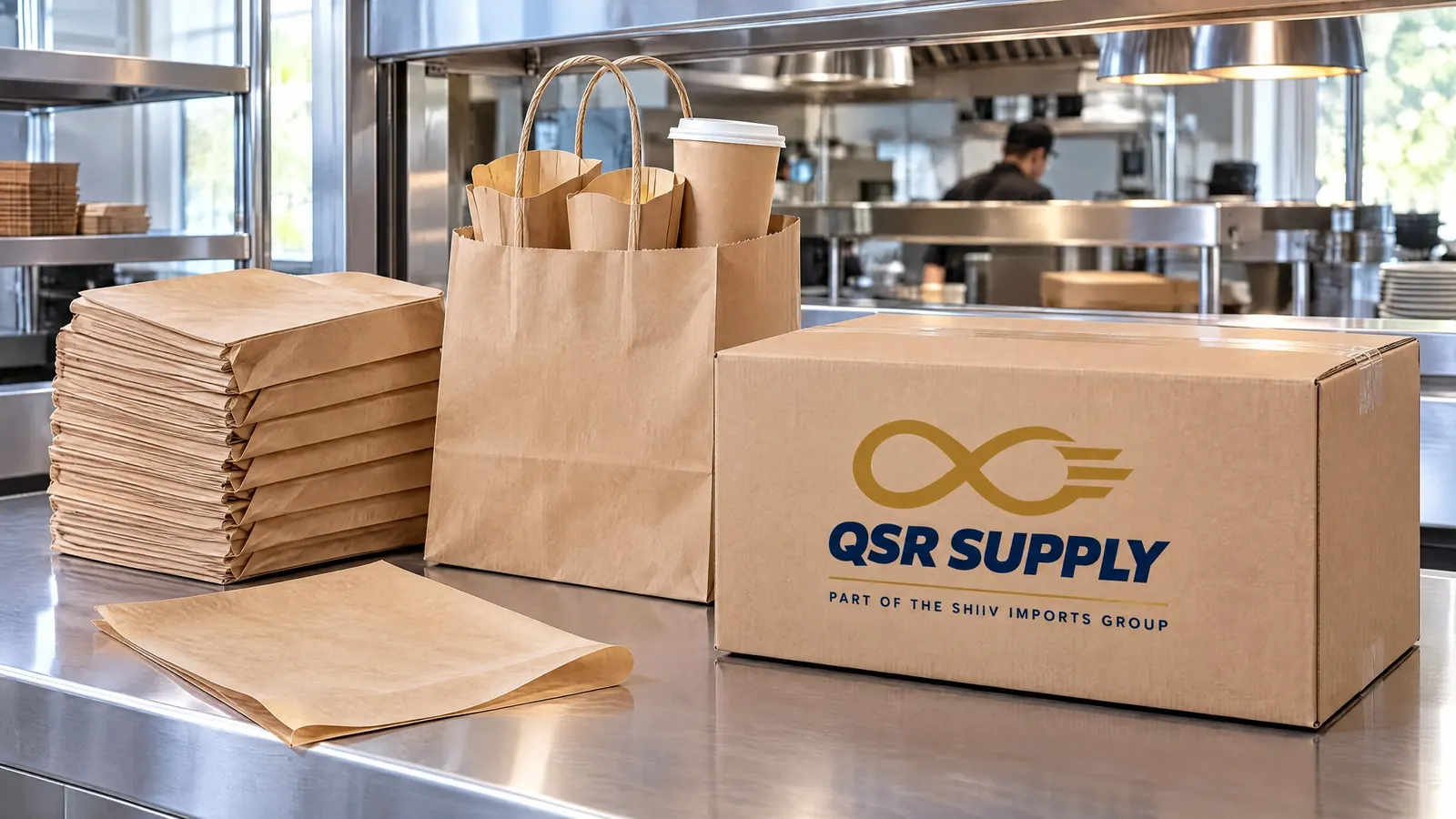
Why paper takeaway bags matter now
Guests still need something to carry fries, burgers, sides and drinks. Lightweight film shopping bags with handles of 35 microns or less are banned nationwide, and several jurisdictions have gone further on thick film bags and plastic-laminated paper shopping bags. That pushes QSR toward SOS bags on the pass, kraft wrap for greasy items, and handled kraft carry bags for multi-item orders.
This guide covers bags you give guests to carry food out. See also our single-use plastic bans and PFAS-free packaging posts. It is not legal advice.
Shopping bag rules that affect paper
| Jurisdiction | Published guidance that matters | Paper takeaway angle |
|---|---|---|
| National (lightweight) | By 1 June 2022 every state and territory had banned lightweight plastic shopping bags with handles at 35 microns or less (National Retail Association, Action on Bags) | Lightweight handled film bags are off the counter |
| South Australia | From 1 September 2024: plastic film shopping bags that are not Australian Standard certified compostable, and plastic-laminated paper and cardboard shopping bags, are banned. Shopping bags made wholly from paper are not banned. The Shopping Bags Act was repealed on 10 April 2025. The rules sit under the Single-use and Other Plastic Products Act | Uncoated kraft is the safe path. Laminated boutique paper is a trap |
| Western Australia | From 1 July 2022: plastic shopping bags with handles are banned, including plastic-laminated paper or cardboard. Paper bags are allowed only without a plastic or cello laminate. Bags without handles are outside that ban | Get a written no-laminate declaration for handled bags |
| ACT | From 1 January 2024: plastic shopping bags with handles are banned, including plastic-laminated paper or cardboard. Bags without handles are not banned. Single-use paper bags are listed as a suitable alternative | Same laminate trap for handled shopping bags |
| NSW | From 1 June 2022: lightweight plastic shopping bags with handles of 35 microns or less are banned, including compostable versions. NSW's Plastics Plan 2.0 says it will phase out all plastic shopping bags. That is a plan, not the same current rule as South Australia, Western Australia and the ACT | Check the NSW EPA pages before treating a laminated paper bag as banned or allowed |
South Australia's Replace the Waste guide states that shopping bags made wholly from paper are not banned, while plastic-laminated paper shopping bags are. Western Australia and the ACT make the same laminate point for handled shopping bags, and both say bags without handles are outside the shopping-bag ban. A no-handle SOS bag is not the same case as a handled carry bag. Compostable plastic bag exemptions, where they exist, need current Australian Standard labelling. They are not a substitute for kraft SOS. Western Australia bans handled shopping bags made from compostable plastic film.
If a bag looks glossy, feels coated, or is sold as laminated, treat it as high risk until composition is confirmed in writing for every jurisdiction you serve.
Bag types and SOS sizes
SOS (self-opening satchel). Block-bottom bag that pops open and stands on the counter. It suits fries, bakery and single items. It usually has no handles.
Kraft carry bag. Wider bag with twisted paper, flat tape or die-cut handles for multi-item takeaway. It is more likely to fall under shopping bag definitions.
Specialty kraft. Grease-resistant or wet-strength grades for hot oily food, and white kraft where a brand kit needs a lighter look.
Trade SOS sizes are often sold as #4, #6, #8, #12, #16 and #20. The number was historically linked to pounds of sugar, and dimensions vary by mill. One published Australian catalogue lists brown kraft SOS from SOS4 (127 by 237 mm, 79 mm gusset, 50 gsm) through SOS20 (305 by 425 mm, 170 mm gusset, 70 gsm), boxed in counts such as 1,000, 500 or 250. Sample first, then lock your own dimensions on the purchase specification.
How to write the specification
| Spec point | What to decide | Why it matters |
|---|---|---|
| Size code and mm | # size or width by gusset by height | Wrong size wastes bags or spills food |
| Base | Block / SOS or flat | Block bases stand open on the pass |
| Colour | Natural kraft or white | Kraft hides oil marks |
| Paper weight | gsm (common SOS lines in one Australian catalogue are 50 gsm and 70 gsm; confirm with the mill) | Too light tears. Too heavy fills stores |
| Grease / oil | Grease-resistant grade or a wrap insert | Soft kraft can stain and fail on hot chips |
| Wet strength | Condensation or short rain exposure | The bag softens and bursts if this is not specified |
| Handles | None, twisted, flat tape or die-cut | Load, comfort and shopping-bag definitions |
| Food contact | Fit for intended use (Standard 3.2.2) | Packaging must not contaminate food |
| Inks and glue | Suitable for food contact, low odour, holds hot loads | Rub-off or glue failure is a guest complaint |
| Pack count | Units per carton | Tight back-of-house storage |
| Change control | No paper, coating or handle change without notice | Stops a laminated or thinner bag slipping in |
Under Standard 3.2.2, food businesses must use packaging that is fit for its intended purpose and not likely to contaminate food. Ask for a food-contact statement that matches hot, oily takeaway use.
Compliance and sourcing checklist
- Confirm whether the SKU is a no-handle SOS food bag or a handled shopping-style bag.
- Get composition in writing: uncoated paper only, or any polymer, cello or plastic laminate.
- Map stores to South Australia, Western Australia, the ACT and the home state. Reject glossy boutique paper unless it is free of banned laminates where you trade.
- Keep compostable plastic bags separate from kraft SOS specs.
- Approve samples on real menu items (hot fries, sauced burgers, a short carry) in at least two store formats.
- Confirm food-contact fitness against Standard 3.2.2 and ask the factory for its food safety system and batch traceability. Those documents belong to the factory. Shiiv Imports holds ISO 9001. QSR Supplier does not claim FSC or other product certifications.
- Lock carton counts, and store bags dry, upright, and in first-in first-out order.
- Lock change control so paper weight, coating or handle style cannot change without new samples and written notice.
Our take
Paper takeaway bags look simple until a laminated boutique bag fails a state rule, or a light SOS bag tears under hot fries. Buyers who specify size, gsm, handles and grease performance, and who treat plastic laminate as a hard stop for handled shopping bags in South Australia, Western Australia and the ACT, get cleaner compliance and fewer pass-line failures.
QSR Supplier sources food packaging, including takeaway bags, for QSR and foodservice through partner factories. See our food packaging and napkins page, what we source and trade catalogues. To set a bag specification across your stores, send a chain brief or talk to our team.
Frequently asked questions
What is an SOS paper bag?
SOS means self-opening satchel. It is a kraft or white paper bag with a block base that opens and stands on the counter, commonly used for fries, bakery and single takeaway items. Trade sizes are often sold as #4 through #20.
Are plastic-laminated paper shopping bags banned in Australia?
Not under one national rule. South Australia (from 1 September 2024), Western Australia (from 1 July 2022 for handled shopping bags) and the ACT (from 1 January 2024) ban plastic-laminated paper shopping bags in the terms set out in their published guides. Bags without handles are outside the WA and ACT shopping-bag bans. Uncoated paper bags are generally treated as an allowed alternative. Confirm the exact definition of shopping bag for each store location.
What paper weight should I use for QSR takeaway bags?
There is no single legal gsm. Foodservice SOS lines commonly sit around 50 gsm for smaller bags and about 70 gsm for larger ones in a published Australian catalogue, but you should approve gsm against tear tests with your real menu weight and hold times.
Do takeaway bags need to meet FSANZ packaging rules?
Yes. Standard 3.2.2 requires food businesses to use packaging that is fit for its intended purpose and not likely to contaminate food. Ask suppliers for assurance that the bag is suitable for the food, temperature and oil level you pack.
Should I use handled kraft bags or SOS bags?
Use SOS for single items on the pass. Use handled kraft when guests carry multiple items. Handled bags are more likely to be treated as shopping bags under state plastic rules, so keep them uncoated and document composition.
Sources
- South Australia Replace the Waste, Guide to the ban on plastic shopping bags and food bag tags
- South Australia EPA, repeal of the Plastic Shopping Bags (Waste Avoidance) Act 2008
- National Retail Association, Action on Bags
- Western Australia, Stage 1 ban, thick plastic bags factsheet
- Western Australia, Plan for Plastics, bags
- Western Australia plastics ban, banned bag items
- ACT Government, single-use plastic ban factsheet for business (November 2024)
- NSW EPA, about the plastics bans
- NSW EPA, Plastics Plan 2.0 frequently asked questions
- FSANZ, Food packaging
- FSANZ, Standard 3.2.2 Food Safety Practices and General Requirements
- Published Australian catalogue of SOS bag sizes and gsm
- Industry explainer of SOS pound-size naming
This guide summarises public government, regulator and industry information current at 16 October 2026. Bag dimensions and gsm examples come from a published Australian catalogue and an industry explainer, and they can vary by mill. It is general information, not legal or regulatory advice. Confirm requirements with your state or territory environment regulator, FSANZ and your food safety adviser, and with your suppliers.