
What PFAS are and why they turn up in takeaway packaging
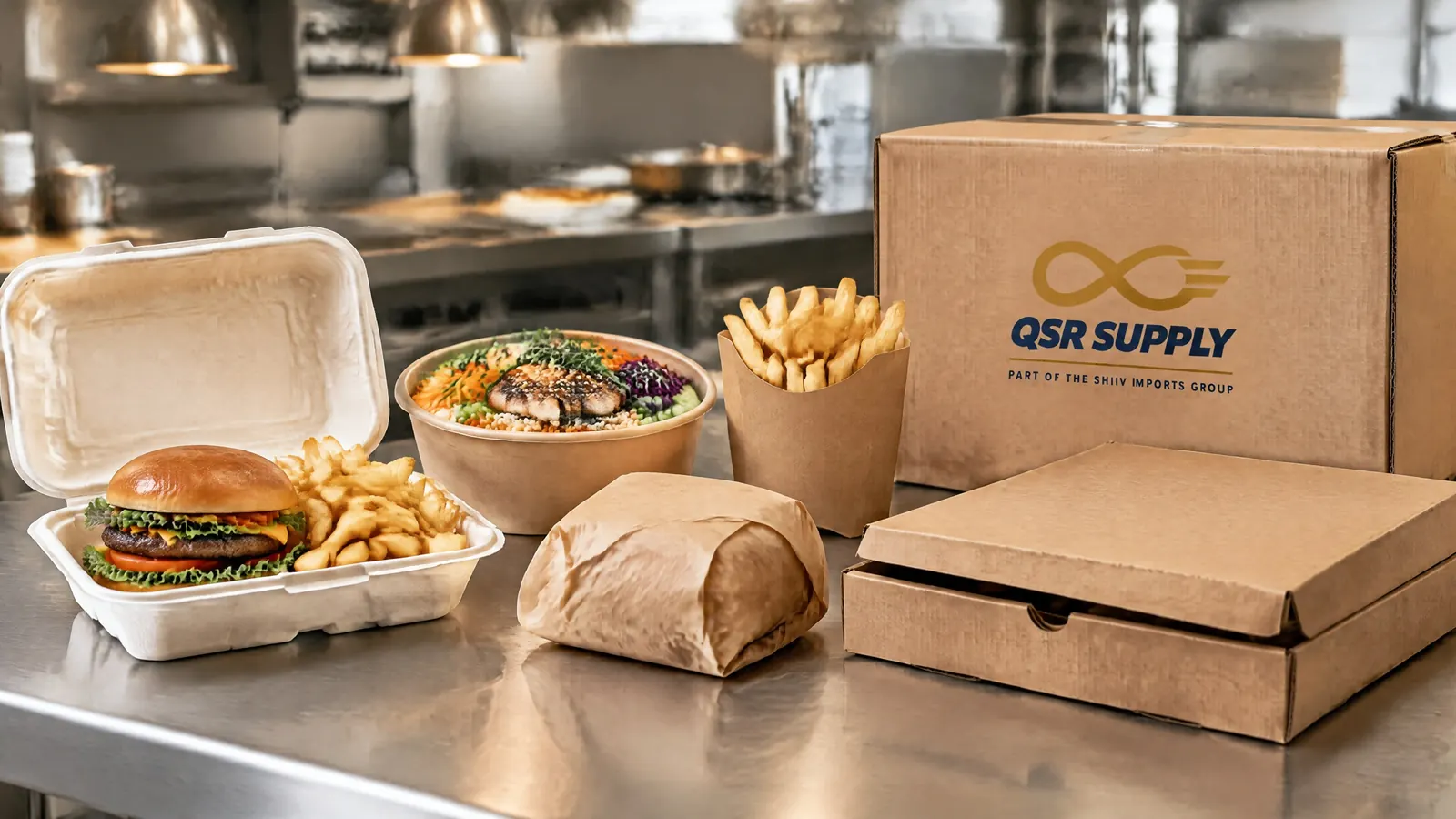
PFAS (per- and polyfluoroalkyl substances) are a large family of manufactured chemicals that resist grease, water and heat. That makes them useful in exactly the places QSR packaging needs help: moulded fibre clamshells and bowls, burger and wrap papers, bakery bags, fry cartons and pizza box liners.
The issue is persistence. PFAS break down very slowly, and the European Commission names takeaway containers, fast-food wrappers, bakery paper and pizza boxes as common uses it wants to restrict. As QSR packaging shifted from plastic to fibre under state single-use plastic bans (see our single-use plastic bans guide), the question of what makes fibre packaging grease-proof became a procurement question, not just a sustainability one.
FSANZ's 27th Australian Total Diet Study found PFAS levels in the general Australian food supply are very low, and FSANZ says there is no current need for maximum levels in the Food Standards Code. So this is mainly a packaging, environmental and customer-trust issue rather than a food recall issue. That said, buyers still carry a duty: Standard 3.2.2 requires food businesses to use packaging that is fit for its intended use and unlikely to contaminate food.
Where the rules stand in Australia and New Zealand (October 2026)
| Measure | What it does | Status |
|---|---|---|
| APCO PFAS Action Plan (2022) | Voluntary phase-out of intentionally added PFAS in fibre-based food contact packaging; indicative threshold of 100 ppm total fluorine, total organic fluorine or extractable organic fluorine | In place; being revised |
| APCO PFAS Discussion Paper (May 2026) | Proposes widening the phase-out to all food contact packaging, new timeframes, testing guidance and possibly a lower threshold for "no intentionally added PFAS" claims | Consultation closed; updated guidance and timelines due by end of 2026 |
| IChEMS Schedule 7 | Prohibits PFOS, PFOA and PFHxS as industrial chemicals, including in mixtures and imported products, with limited exemptions | In force from 1 July 2025 |
| Senate Select Committee on PFAS, Recommendation 35 | Calls on the government to fast-track reforms removing PFAS from all food contact packaging imported into or used in Australia | Recommendation only (final report, November 2025) |
| NSW EPA FOGO rules | Fibre-based food contact packaging (cups, plates, bowls, pizza boxes, serviettes) excluded from FO and FOGO bins, partly because it can contain PFAS | Current NSW guidance |
| New Zealand | PFAS firefighting foams banned from December 2025; import and manufacture of cosmetics containing PFAS banned from 31 December 2026 | The cited EPA page does not set a food packaging rule |
Two points from the Senate report matter for buyers. First, the committee noted that industry's own results suggest 10 per cent of food contact packaging still contains PFAS, so voluntary action has not finished the job. Second, it observed that Australia imports most of its packaging, which puts the spotlight on importers and on the documents they hold.
Why the EU change affects Australian QSR supply
From 12 August 2026, the EU Packaging and Packaging Waste Regulation stops food contact packaging being placed on the EU market if PFAS reach or exceed:
- 25 parts per billion for any single PFAS (targeted analysis)
- 250 parts per billion for the sum of targeted PFAS
- 50 parts per million for total PFAS, including polymeric PFAS
The rule covers both intentionally and unintentionally added PFAS, and the Commission has confirmed there is no general stock run-out period for packaging first placed on the market after that date.
Australia sources much of its QSR packaging from the same factories in Asia and Europe that supply the EU. Factories that supply the EU have to meet these limits for stock placed on the EU market, and buyers here can ask whether the same grade and the same test evidence are available, rather than accepting an older formulation.
How PFAS testing works in plain terms
Buyers do not need to run a lab, but it helps to know what the reports mean.
- Total fluorine (TF) is a common screening measure. Combustion ion chromatography is one method described in the APCO action plan. Under the APCO plan, total fluorine, total organic fluorine or extractable organic fluorine above 100 ppm is treated as intentionally added PFAS, so a result under 100 ppm is the usual Australian screening benchmark. EU guidance treats total fluorine under 50 mg/kg as a compliance screen for the 50 ppm total PFAS limit. That screen is separate from the APCO threshold.
- Organic versus inorganic fluorine testing is used when total fluorine is higher, because some minerals and fillers contain fluorine that is not PFAS.
- Targeted PFAS analysis (for example LC-MS/MS) measures specific PFAS compounds, sometimes after a total oxidisable precursor (TOP) step that converts hidden precursors into measurable forms.
Ask for reports from an accredited laboratory, dated within the last 12 months, tied to the exact product code and coating.
PFAS-free alternatives for QSR formats
| Format | Common PFAS-free approach | Buyer check |
|---|---|---|
| Moulded fibre clamshells and bowls | Tightly refined pulp for natural grease resistance, or water-based barrier coatings | Grease and steam performance with your hottest, oiliest items |
| Burger and wrap papers | Glassine or greaseproof papers made by refining, or water-based coatings | Grease strike-through after holding time |
| Fry cartons and scoops | Coated board with a declared non-fluorinated barrier | Rigidity when hot, print rub |
| Pizza boxes and liners | Uncoated corrugated with a declared PFAS-free liner | Oil marking, delivery time |
| Hot cups and bowls | Aqueous or bio-based linings | State plastic ban fit and end-of-life claims |
Compostable claims need extra care. The Australasian Bioplastics Association requires certified compostable products to show no intentionally added fluorinated chemicals and total fluorine no higher than 100 ppm. If a pack is marketed as compostable but has no certification or fluorine data, treat the claim as unproven. Ask the factory for the certification and the test report. A sourcing partner does not hold those certificates.
PFAS-free packaging checklist for multi-site QSR
- Write it into the specification: "no intentionally added PFAS" for every food contact component, including coatings, inks, adhesives and liners.
- Request current total fluorine results for each SKU, with the lab name, method and date.
- Ask for a supplier declaration naming the barrier coating chemistry, not just a "PFAS-free" sticker.
- Check EU-grade availability from overseas factories that already supply PPWR-compliant stock.
- Trial in your own stores with your hottest, greasiest items and real holding and delivery times.
- Review claims on pack and online so "compostable" or "PFAS-free" wording is backed by evidence.
- Lock change control so the factory cannot switch pulp, coating or ink without written notice and new test results.
- Re-test on a schedule, at least yearly and whenever the factory, coating or origin changes.
The same discipline applies to napkins and other tissue that touches food, covered in our napkins and food-hygiene tissue guide.
Our take
The direction is clear even without a national ban. APCO's revised plan is due by the end of 2026, the Senate wants regulation, and the EU has already moved. QSR operators who specify and evidence PFAS-free packaging now will avoid a rushed changeover later and have a straight answer when guests, franchisees or councils ask.
QSR Supplier sources food packaging and napkins for QSR and foodservice, alongside the wider range on our what we source page. To set a PFAS-free specification across your stores, send a chain brief or talk to our team.
Frequently asked questions
Is PFAS banned in food packaging in Australia?
Not by a specific law as of October 2026. APCO runs a voluntary phase-out of intentionally added PFAS in fibre-based food contact packaging, and three PFAS (PFOS, PFOA and PFHxS) have been prohibited as industrial chemicals since 1 July 2025. A Senate committee has recommended fast-tracking regulation for all food contact packaging.
Which QSR packaging is most likely to contain PFAS?
Grease-resistant fibre items are the main risk: moulded fibre clamshells and bowls, burger and wrap papers, bakery bags, fry cartons and pizza box liners. Fibre packaging is the focus of APCO's current phase-out, and its 2026 proposals would widen that to all food contact packaging.
How do I know if my packaging is PFAS-free?
Ask your supplier for a total fluorine test from an accredited lab for each product, plus a written declaration that no PFAS are intentionally added. A low total fluorine result, such as under 100 ppm, is the usual screening benchmark in Australia.
What did the EU change in August 2026?
From 12 August 2026, food contact packaging cannot be placed on the EU market if PFAS are at or above 25 ppb for any single PFAS, 250 ppb for the sum of targeted PFAS, or 50 ppm for total PFAS. Buyers can ask factories that also supply Australia whether the same grade and test evidence are available.
Are compostable takeaway containers PFAS-free?
Not automatically. Look for certification from the Australasian Bioplastics Association, which requires no intentionally added fluorinated chemicals and total fluorine of no more than 100 ppm, and ask for the test report.
Sources
- APCO, Phasing out PFAS from food contact packaging (2026 PFAS Discussion Paper)
- APCO, Action Plan to Phase Out PFAS in Fibre-Based Food Contact Packaging (2022)
- APCO, consultation closed update (August 2026)
- Parliament of Australia, Senate Select Committee on PFAS, Final report, Chapter 12 (Recommendation 35)
- Parliament of Australia, Senate Select Committee on PFAS, Final report, Chapter 10 (IChEMS Schedule 7)
- Parliament of Australia, Senate Select Committee on PFAS, Final report, List of recommendations
- FSANZ, Chemicals in food packaging
- FSANZ, Perfluorinated compounds (PFAS) and the 27th Australian Total Diet Study
- European Commission, New EU rules on packaging enter into application (11 August 2026)
- Food Packaging Forum, PPWR PFAS limits apply from August 12
- NSW EPA, What can and can't go in your FOGO bin
- Australasian Bioplastics Association, PFAS explained
- New Zealand EPA, PFAS controls
This guide summarises public government, regulator and industry information current at 14 October 2026. APCO's revised PFAS guidance is expected by the end of 2026 and rules may change. It is general information, not legal or regulatory advice. Confirm requirements with APCO, DCCEEW, FSANZ, your state or territory regulator, or the EPA and MPI in New Zealand, and with your suppliers.