
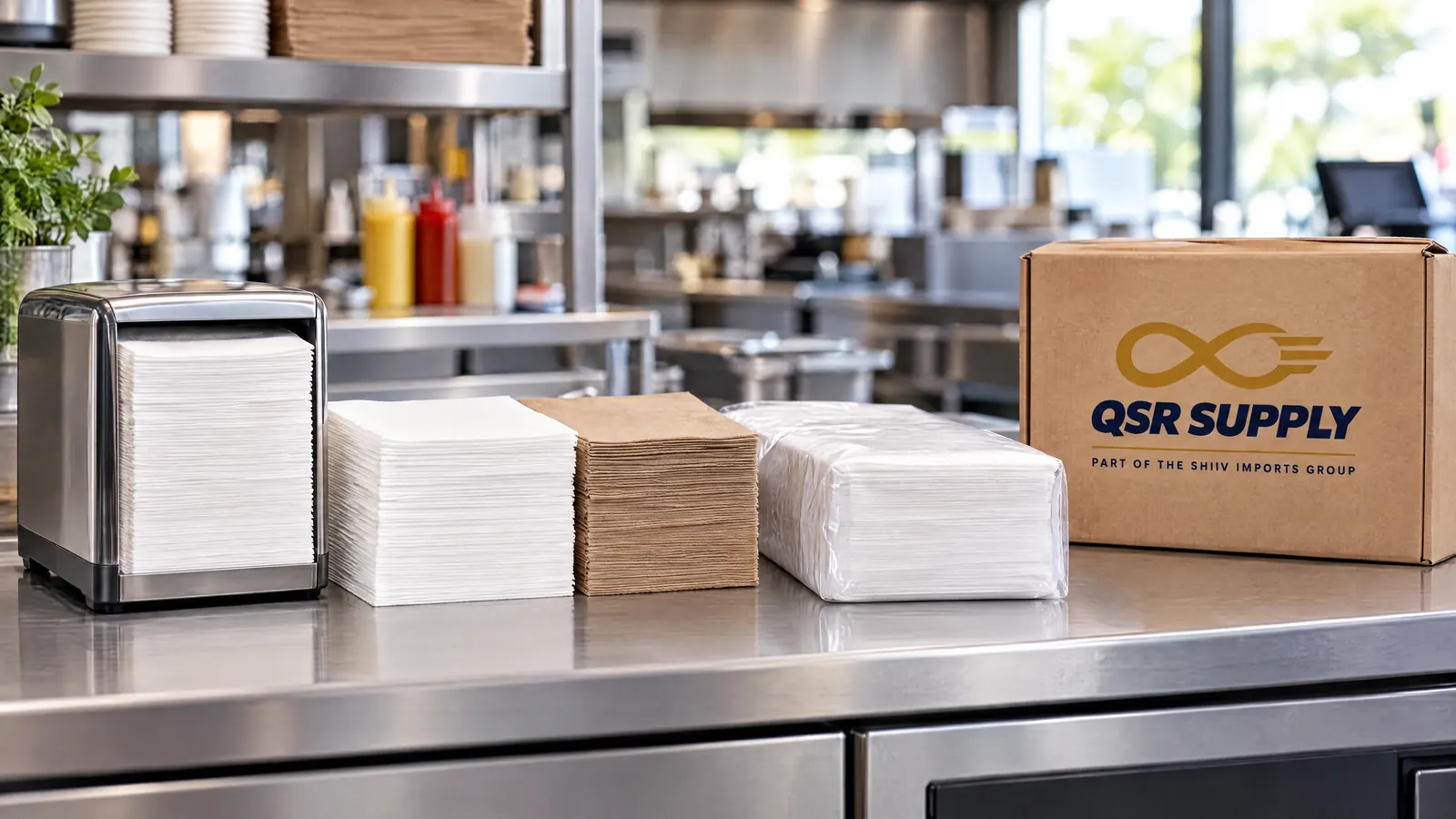
Why napkins matter for QSR in 2026
Napkins look small on a purchase order. On the floor they touch every tray, drive-thru bag and counter wipe. When the fold does not match the dispenser, staff restack. When the ply is too light for a greasy meal, guests take two or three. When pack counts differ by store, reordering becomes guesswork.
Australian QSR operators are under pressure to cut waste and simplify labour. The End Food Waste CRC's 2026 QSR Sector Action Plan notes about 26,630 QSR businesses and 226,000 people employed as of January 2025, and flags time pressure and understaffing in store. Napkins are not food waste, but systems that reduce double-pulling and refill trips still free crew for service.
That is why the napkin specification belongs next to containers, cups and bags on a packaging brief. Our food packaging, napkins and bags page lists the fields buyers usually need. Related packaging rules sit beside our single-use plastic bans guide.
What to put in a napkin specification
Ply and paper weight
Foodservice napkins commonly brief as 1, 2 or 3 ply. Higher ply usually feels thicker and may mean guests take fewer sheets, but only if the napkin also fits the dispenser. If you have a known paper weight (gsm), put that target in the brief.
Fold types: quarter fold, D-fold and interfold
Quarter fold (Qtr fold) is the familiar compact square: folded in half, then in half again. Bonson notes it suits cafés, restaurants, takeaway and catering and stacks easily on tables or counters.
D-fold (dispenser fold) is made for compatible tabletop dispensers. Removing one napkin does not automatically pull the next forward.
Interfold (also called V-fold) overlaps each napkin with the next so removing one presents the next. Bonson states this can help control consumption in busy venues. Huhtamaki Australia's 2025 Napkins Fold Guide lists example interfold sizes around 105 mm x 165 mm folded and 210 mm x 165 mm unfolded. Exact sizes vary by SKU, so always state both folded and open size, and name the dispenser model with the fold.
Open size, dispenser fit, colour and pack counts
Folded size decides dispenser fit. Open size decides wipe area. Write the dispenser brand and model into the brief, and say whether guests or crew pull the napkin.
High-capacity, one-at-a-time systems are sold into Australian foodservice to cut over-taking and refill labour. Tork's Australian Xpressnap materials cite research vs traditional dispensers reporting napkin waste reductions of up to about 43% and consumption reductions of up to about 38%. Treat those figures as system-specific claims, not a guarantee for every venue. The buyer lesson still holds: dispenser fit changes how many napkins leave the pack.
White and kraft are the usual colours. Brand print needs approved artwork and a proof. State napkins per pack and packs per carton.
Specification checklist table
| Spec point | Why it matters | What to state |
|---|---|---|
| Ply and weight | Changes feel and how many sheets guests take | 1, 2 or 3 ply; target gsm if known |
| Fold type | Must match dispenser or counter presentation | Quarter fold, D-fold, interfold/V-fold, or other named fold |
| Folded and open size | Dispenser fit and usable wipe area | Both dimensions in mm |
| Dispenser model | Wrong fold or size jams or over-dispenses | Brand/model or system code; guest or staff pull |
| Colour and print | Tray look and brand consistency | White, kraft or branded colours; plain or printed details |
| Pack and carton counts | Storage and reorder rhythm | Napkins per pack; packs per carton |
| Food-hygiene tissue (if needed) | Back-of-house and washroom lines | Hand towel / toilet / facial type, fold, size, dispenser |
Food-hygiene tissue on the same brief
Many chains brief napkins with hand towels, toilet tissue and facial tissue on the same packaging and hygiene brief. For hand towels, state fold, size, ply, colour and the towel dispenser model. Do not assume napkin and hand-towel dispensers share the same refill.
Food contact, storage and hygiene (FSANZ)
FSANZ summarises Standard 3.2.2 for food businesses packaging food: use material fit for purpose, not likely to cause food contamination, and handled so food is unlikely to become contaminated during packaging.
Practical takeaways:
- Buy from a reputable source and ask for assurance where materials may contact food.
- Use clean, undamaged stock.
- Store in a secure and clean place.
If printed napkins or wraps may contact oily food, ask the supplier for assurance the material is suitable. That sits beside allergen controls covered in our allergen labelling guide.
Multi-site consistency checklist
- Lock one master specification for each napkin and tissue SKU across the estate.
- Name the dispenser in every store. Photograph current units if model codes are missing.
- Approve a physical sample in the actual dispenser before a full rollout.
- Align pack and carton counts so every store reorders the same way.
- Put change control in writing for fold, ply or dispenser changes.
- Train refill habits so crew load the correct fold orientation.
- Review waste at the bin and the carton. Guest double-pulling and crushed cartons both show up as cost.
- Keep storage rules visible so hygiene practice matches the food safety plan.
Our take
A napkin that almost fits is a daily friction tax on crew and guests. Treat napkins like any other QSR specification: ply, fold, sizes, dispenser, colour and pack counts written down, samples checked in the real hardware, and the same SKU across every site.
QSR Supplier sources food packaging, napkins and food-hygiene tissue alongside other foodservice lines. To standardise lines across stores, send a chain brief or talk to our team.
Frequently asked questions
What should a QSR napkin specification include?
Ply (and weight if known), fold type, folded and open size, the dispenser model the napkin must fit, colour or print details, and napkins per pack plus packs per carton.
What is the difference between D-fold and interfold napkins?
Both are dispenser formats. With D-fold, taking one napkin does not automatically present the next. With interfold, napkins overlap so removing one presents the next, which can help control use in busy venues.
Do napkin folds have standard sizes in Australia?
Trade catalogues publish typical folded and open sizes by fold type, but sizes still vary by SKU. Always state millimetre dimensions for your chosen line rather than relying on the fold name alone.
Can food-hygiene tissue be briefed with napkins?
Yes. Hand towels, toilet tissue and facial tissue are commonly sourced on the same packaging and hygiene brief, with each line's own fold, size and dispenser called out.
How does FSANZ apply to napkins and packaging storage?
Under Standard 3.2.2, packaging used with food must be fit for purpose and not likely to contaminate food. FSANZ also advises clean, undamaged stock, hygienic handling and secure, clean storage. Apply the same discipline to napkin and tissue cartons in the storeroom.
Sources
- FSANZ, Food packaging (Standard 3.2.2 clause 9)
- QSR Supplier, Food packaging, napkins and bags
- Bonson-Savpac, Understanding Napkin Fold Types
- Huhtamaki Australia, Napkins Fold Guide 2025
- Tork Australia, Tork Xpressnap Drive Thru Napkin Dispenser
- End Food Waste Australia, Quick Service Restaurant Sector Action Plan Report 2026
- QSR Supplier Insights, Single-use plastic bans in Australia
This guide summarises public regulator and industry information current at 12 October 2026. It is general information, not legal or food safety advice. Confirm requirements with your state or territory food regulator, or MPI in New Zealand, and with your suppliers. Dispenser performance figures cited from manufacturer materials are system-specific and not a guarantee for every site.