
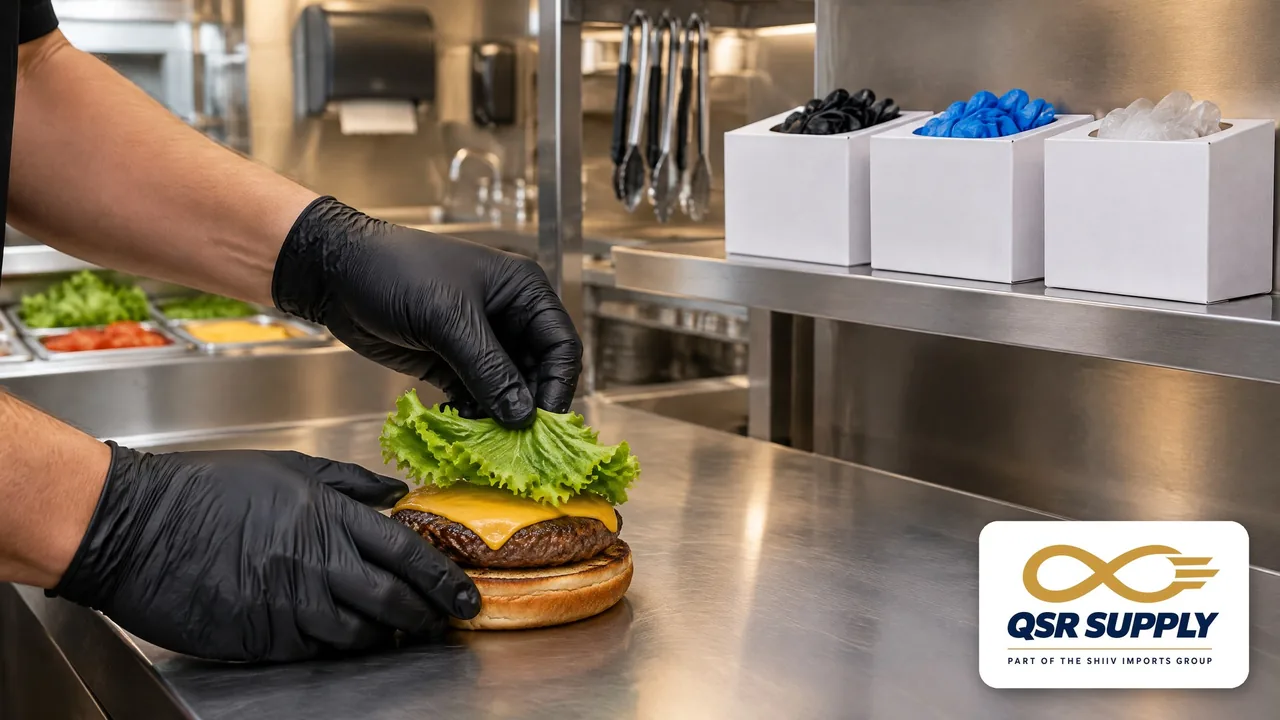
What the food safety rules say about gloves
Gloves are widely used in a QSR kitchen. Standard 3.2.2 does not require them. Clause 15 does require a food handler, while handling food, to take all practicable measures to prevent unnecessary contact with ready-to-eat food. Hands must be washed whenever they are likely to be a source of contamination, immediately before working with ready-to-eat food after handling raw food, and immediately after using the toilet. The same clause also requires a wash before starting or restarting food handling that involves unprotected food, after smoking, coughing, sneezing, using a tissue, eating or drinking, and after touching hair, scalp or a body opening. A body opening includes the mouth, nose and ears. Washing means the hand-washing facilities provided, soap or other effective means, and warm running water, then drying on a single-use towel or in another way that is not likely to transfer pathogens to the hands.
FSANZ's advice to food handlers is direct: do not touch ready-to-eat food with bare hands, and use tongs or gloves. Its guide to the standard also says that hands, gloves or equipment used on raw chicken may carry bacteria to cooked chicken and other food, so gloves have to be changed between tasks, not only worn.
From December 2023, Standard 3.2.2A requires food handler training and a food safety supervisor for category one and category two businesses. Category one businesses must also be able to show that prescribed food safety controls are being met, usually by keeping records. Category one is a food service business that processes unpackaged potentially hazardous food into food that is ready to eat and still potentially hazardous, then serves it. Many QSR kitchens that cook raw product and serve it ready to eat sit in that category. Personal hygiene is part of the training those businesses must cover, so the gloves you buy should make the hand-washing and glove-change routine easy to follow.
Gloves do not replace hand washing
A glove can carry bacteria. Safe Food Australia says disposable gloves may be used for one task only, so they are changed between handling raw food and handling ready-to-eat food, and between cleaning or removing garbage and handling food. Gloves are also changed if they become contaminated. Once a glove is taken off, it cannot be reused, and it is not washed or sanitised and put back on. Hands are washed before gloves go on, and again between glove changes. Touching hair, scalp or a body opening is a hand-wash point under clause 15, so the gloves come off for that wash.
Nitrile, vinyl, polyethylene or latex
Each material has a place. A chain usually needs two glove types, not one.
Nitrile
Nitrile is a synthetic rubber. It does not contain natural rubber latex proteins. ASCIA says people who need gloves can use vinyl or synthetic rubber. Nitrile is a synthetic rubber, and it is a good all-round choice for burger assembly, sandwich and wrap lines, and most back-of-house prep, where a close-fitting glove is worn for the task. Ask the manufacturer for a food-contact declaration. Not every nitrile glove is made for food use.
Vinyl (PVC)
Vinyl is used for short tasks. In Japan, a 2001 study of retail packed lunches found that PVC gloves used in the kitchen contained 22% or 41% by weight of the plasticiser DEHP, and that spraying those gloves with alcohol increased the amount of DEHP that moved into the food. Japan's Ministry of Health, Labour and Welfare recorded that a June 2000 notice had already told businesses to avoid using DEHP-containing PVC gloves with food. A June 2002 food sanitation council report then recommended that utensils, containers and packaging made from PVC containing DEHP should not be used with oily or fatty food, unless the DEHP cannot migrate into the food. If you use vinyl, ask for a statement that the gloves do not contain DEHP, and keep them away from fried and oily product.
Polyethylene (PE)
Thin polyethylene gloves are used for very quick tasks, such as handing over a pastry or adding a garnish. They are not a substitute for a close-fitting glove on a longer prep task.
Latex
Latex carries an allergy risk for staff and customers. Latex proteins from natural rubber latex gloves, especially powdered gloves, can transfer to food during preparation. The Occupational Dermatology Research and Education Centre tells food handlers not to wear latex gloves, powdered or not, and names plastic or vinyl as the types to use when gloves are needed. ASCIA advises people with latex allergy to avoid takeaway food prepared or served by people wearing latex gloves, and to use vinyl or synthetic rubber gloves if they need to wear gloves. For a QSR brand, that is a reason to keep latex out of the kitchen.
Where glove supply is heading
More than 400 billion gloves are produced globally each year, and Malaysia and Thailand account for about 70% of supply, according to a January 2026 industry market update. Nitrile is made from nitrile butadiene rubber (NBR). That update points to NBR supply and freight as constraints on nitrile gloves. This guide does not quote prices.
- US tariffs. On 1 January 2026, the tariff on Chinese examination nitrile gloves doubled from 50% to 100%. The same update says that rate sits on top of a 20% reciprocal tariff, so the total on those gloves is 120%. It expects a larger share of supply to come from Southeast Asia as demand shifts away from China, though capacity expansion takes time.
- From a May peak to a September low. RHB Research, reported by the New Straits Times on 21 September 2026, said generic nitrile selling prices had fallen from a May peak to a September low. Malaysian makers planned rises from October, with another possible in November. Much of the October rise was described as cover for an expected 40 to 50% increase in Malaysian gas tariffs. The same note said a large Chinese maker had already raised prices from 9 September.
- The June picture was different. On 18 June 2026, BIMB Research told The Star that US-bound Malaysian nitrile prices were above the downturn trough, after an NBR supply disruption let makers pass costs through, and that second-half prices were likely to stay broadly stable. That June view is not the September view.
For Australian buyers, those are factory indicators in another currency. Landed cost also depends on the exchange rate, sea freight and the distributor's margin, so the effect on an invoice can be smaller or later. The direction reported in September was higher selling prices from October, not lower.
A glove specification checklist
Write gloves into the consumables spec the same way you would a packaging item. Ask the supplier to confirm each point.
Product
- Material (nitrile, vinyl or polyethylene), colour, and whether the gloves are powder free
- Thickness, in mil or grams per glove, and length
- Sizes available, with a fit trial on your own teams
- For vinyl, a statement that the gloves do not contain DEHP
Food safety and documents
- A food-contact declaration from the manufacturer, with migration test reports
- A statement that the gloves contain no natural rubber latex
- The factory's food-safety or quality documents, and batch traceability on every carton. Those documents belong to the factory. Shiiv Imports holds ISO 9001.
- The acceptable quality level (AQL) for pinholes, stated on the spec
Supply and storage
- Pack count per box and boxes per carton, and the dispenser box design
- Shelf life and storage conditions: cool, dry, and out of direct sunlight
- Lead time, country of manufacture, and an approved alternative source
Our take
Gloves are a small line on a brief and a large line in a store. A glove that tears creates waste, rework and food safety risk. Match the material to the task, keep latex out, and lock a written spec that includes food-contact paperwork. Talk to your supplier about the rises flagged from October 2026. This guide does not quote prices.
QSR Supplier does not manufacture gloves, and gloves are not a listed line on what we source. Shiiv sources food, packaging and hygiene lines to a buyer's brief. Shiiv Imports holds ISO 9001. Factory food-safety documents belong to the factory. See the food packaging and napkins page, and the guides to napkins and food-hygiene tissue, chicken and egg supply and allergen labelling. To put gloves or other kitchen consumables on a brief, send a chain brief or talk to our team.
Frequently asked questions
Do food handlers in Australia have to wear gloves?
No. Standard 3.2.2 does not make gloves compulsory. It requires food handlers to avoid unnecessary contact with ready-to-eat food and to wash their hands at set times. FSANZ advises using tongs or gloves rather than bare hands for ready-to-eat food.
Are nitrile gloves food safe?
Nitrile gloves made and tested for food contact are widely used in food handling. Ask the manufacturer for a food-contact declaration and migration test reports. Not every nitrile glove on the market is made for food use.
Should a QSR kitchen use nitrile or vinyl?
For most QSR tasks, nitrile. It is a close-fitting synthetic rubber. Vinyl suits short tasks. If you buy vinyl, ask for a statement that it does not contain DEHP, and keep it away from oily food.
Can you use latex gloves in a food business?
It is not banned. Avoid it. Latex proteins can transfer to food, and ASCIA advises people with latex allergy to avoid takeaway food prepared or served by people wearing latex gloves.
How often should food handlers change gloves?
Change gloves when the task changes, between raw food and ready-to-eat food, and between cleaning or removing garbage and handling food. Change them if they become contaminated. A glove that has been taken off is not reused. Wash hands before the next pair. Touching hair, scalp or a body opening means a hand wash, so the gloves come off.
Why are glove prices going up in 2026?
This guide does not quote prices. Nitrile supply costs follow rubber, gas and freight. RHB Research, reported in September 2026, said selling prices had fallen from a May peak to a September low, and that Malaysian makers planned rises from October, in large part to cover an expected 40 to 50% rise in gas tariffs. A large Chinese maker had already raised prices from 9 September.
Sources
- Federal Register of Legislation, Standard 3.2.2 Food Safety Practices and General Requirements
- FSANZ, health and hygiene advice for food handlers
- FSANZ, Safe Food Australia, guide to Standard 3.2.2
- FSANZ, Standard 3.2.2A overview
- ASCIA, latex allergy FAQ
- Occupational Dermatology Research and Education Centre, food handlers
- Tsumura and others, Food Additives and Contaminants (2001), DEHP in packed lunches and PVC gloves
- Japan Ministry of Health, Labour and Welfare, Food Sanitation Council report, June 2002
- AMMEX, disposable glove market update, January 2026
- The Star, Malaysian glove industry outlook, 18 June 2026
- New Straits Times, Malaysian glove makers and October supply costs, 21 September 2026
This guide summarises public government, industry, research and news information current at 28 October 2026. It does not quote glove prices. Selling-price directions are factory indicators reported by analysts and can change. It is general information, not legal, food safety or procurement advice. Confirm requirements with your state or territory food regulator, your food safety adviser and your suppliers.