
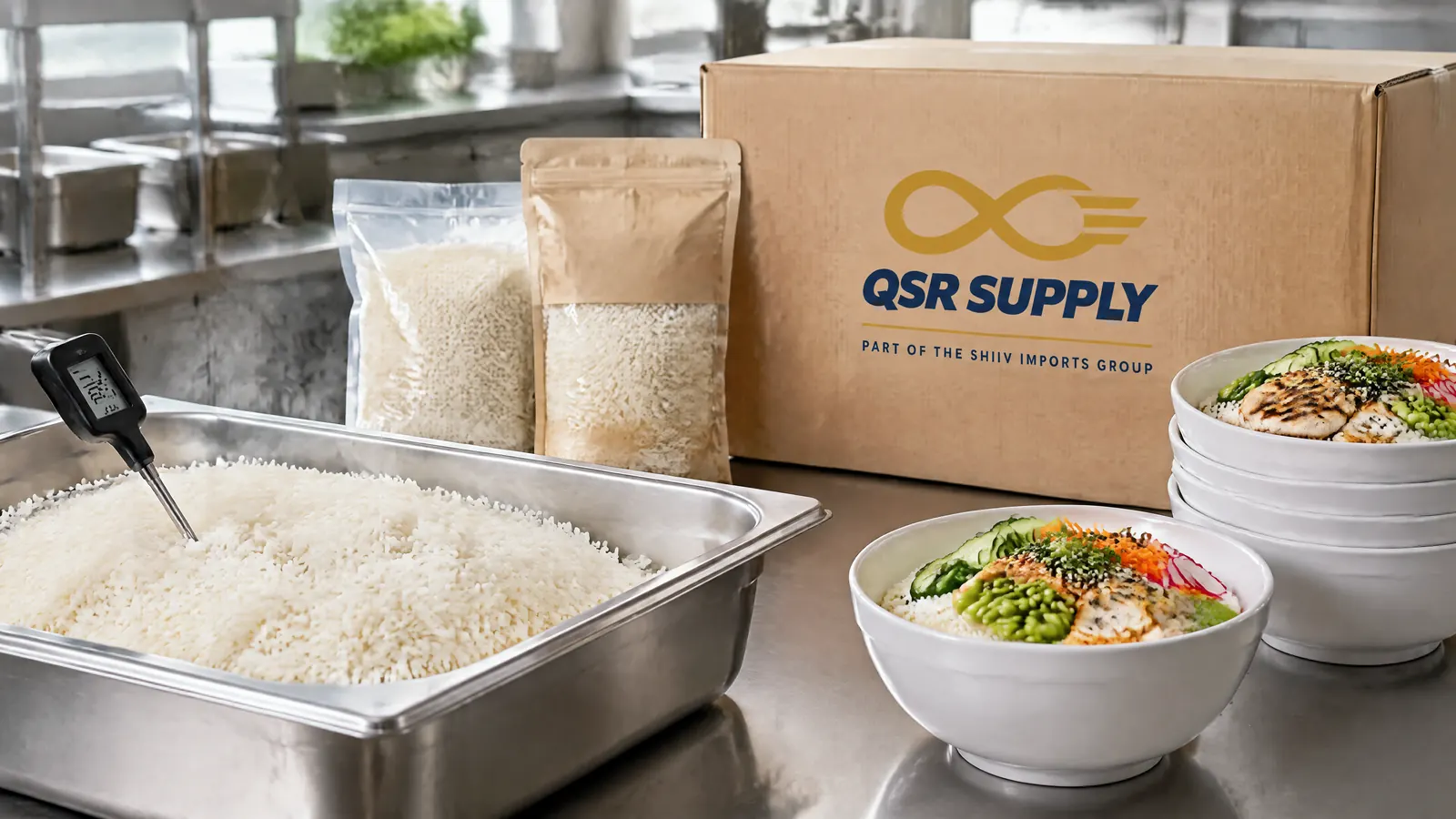
Why rice supply is a QSR issue in 2026
Rice sits under poke bowls, burrito bowls, curries, fried rice, rice boxes and kids' meals. For many chains it is the highest-volume dry or frozen line on the order guide, and the one guests notice first when texture changes.
The local supply picture has tightened for a second year running:
- ABARES (Australian Crop Report, September 2026) forecasts rice production to fall by about 22% to around 137,000 to 139,000 tonnes in 2026-27, driven by an 18% drop in area planted. Low water availability and higher irrigation water prices are the main reasons.
- USDA FAS/Canberra (Grain and Feed Update, 24 July 2026) forecasts milled rice production of 79,000 tonnes for 2026-27, roughly a quarter of the previous ten-year average. The two agencies measure on different bases, but both point the same way.
- The same USDA report forecasts imports of 325,000 tonnes, up about 15% on an estimated 285,000 tonnes in 2025-26, against a domestic consumption forecast of 420,000 tonnes. Thailand, India and Vietnam together supply almost 80% of Australia's rice imports.
- SunRice told the market in June 2026 that the 2026 Australian crop is substantially smaller and that it expects global sourcing to support continuity for its branded markets.
There is also a grain-type point. USDA notes that Australia mainly grows medium-grain rice, while Australian consumers buy a wide range including long-grain, jasmine and basmati. So many QSR menus already depend on imported rice, and a small local crop simply widens that dependence.
We saw a similar pattern with potatoes, covered in our frozen chip supply guide: when the local crop is constrained, buyers who have already approved a second origin have the most options.
Rice formats for QSR and foodservice
| Format | Where it fits | What to check |
|---|---|---|
| Milled white rice (raw) | Stores cooking rice daily in rice cookers or combi ovens | Grain type, variety, broken percentage, cooked yield, cook method fit |
| Parboiled rice | High-volume hot holding where grains need to stay separate | Holding performance, texture after reheating, import pathway |
| Precooked frozen rice | Rice bowls, fried rice and catering where speed and consistency matter | Freezer space, thaw and regeneration method, portion or bulk pack |
| Precooked shelf-stable rice (retorted pouch or tray) | Sites with limited cold storage, back-up stock, remote or event sites | Shelf life, heat-up method, pack size versus labour per portion |
| Seasoned or flavoured precooked rice | Signature sides and limited-time menu items | Ingredient list, allergens, sodium, consistency across batches |
Precooked formats move the cooking and cooling step to the manufacturer. That can reduce labour, rice cooker capacity issues and batch-to-batch variation across sites. It does not remove the need for safe storage, regeneration and hot holding once the pack is opened or thawed.
Cooked rice food safety: the rules buyers should brief
Cooked rice is a potentially hazardous food. FSANZ's guide to Standard 3.2.2 explains that the cooling limits are based on controlling spore-forming bacteria, and notes that Bacillus cereus grows fastest between 30°C and 40°C. Its spores can survive cooking, which is why slow cooling of cooked rice is a known risk.
Cooling (Standard 3.2.2, clause 7(3)): cool cooked potentially hazardous food from 60°C to 21°C within two hours, then from 21°C to 5°C within a further four hours, unless the business can show another process is safe. The FSANZ guide uses a rice example: a restaurant cooling a full rice cooker batch in one container in the coolroom overnight, which failed the cooling times when the centre temperature was checked. Dividing batches and spreading rice in shallow trays helps.
2-hour / 4-hour rule: once ready-to-eat potentially hazardous food comes out of refrigeration, total time between 5°C and 60°C decides what happens next. Under two hours it can be used or refrigerated again. Between two and four hours it must be used. Over four hours it must be thrown out.
Standard 3.2.2A: category one businesses, which include many restaurants and takeaway shops handling unpackaged ready-to-eat food, need a food safety supervisor, trained food handlers and records (or other evidence) of key controls such as cooling. FSANZ says records should be kept for at least three months.
For buyers, the practical point is that format choice changes the food safety workload in store. Brief your supplier on how the rice will be regenerated and held, and ask for written storage, thawing and reheating directions that fit your kitchen.
Importing rice: what to check before you approve a line
Most QSR rice in Australia is imported or blended from imported stock, so import compliance is part of the specification.
- Biosecurity (BICON): DAFF sets import conditions for rice under the BICON case for rice for human consumption or processing. Conditions differ by format. Potentially viable rice such as brown rice can need an import permit and may need treatment against pests such as khapra beetle. Parboiled rice with the germ intact has its own pathway, which DAFF's 2019 notice says requires a manufacturer's declaration of the soaking and steaming process and may be checked by germination testing. Retorted rice products have separate conditions again. Check the current BICON case for your exact product before ordering.
- Food safety (IFIS): imported food referred to DAFF under the Imported Food Inspection Scheme is held until inspected. Inspection includes a visual and label assessment, and tests depend on the food type.
- Contaminant limits: Schedule 19 of the Food Standards Code sets a total arsenic limit of 1 mg/kg for cereal grains, including rice, and a cadmium limit of 0.1 mg/kg for rice. Ask for current certificates of analysis that cover these.
- Labelling and allergens: plain rice is simple, but seasoned or flavoured rice needs a full ingredient and allergen declaration. Our allergen labelling guide covers the supplier checklist.
Rice specification checklist for multi-site QSR
- Name the grain type and variety (for example long-grain, jasmine, basmati or medium-grain), not just "white rice".
- Choose the format for each menu use: raw, parboiled, precooked frozen or precooked shelf-stable.
- Set a cooked target: texture, grain separation, cooked yield and holding time you need.
- State pack size and carton count to match rice cooker batches, freezer space or portioning.
- Approve a primary and a back-up origin with samples cooked in your own equipment.
- Request documents: certificate of analysis (arsenic, cadmium, micro for precooked lines), BICON pathway, manufacturer's declarations where needed, and storage and regeneration directions.
- Lock change control in writing so variety, origin or process changes are notified before shipment.
- Align store procedures for cooling, regeneration and hot holding with your food safety program and Standard 3.2.2A records.
Our take
A small Australian crop does not mean rice will run out for QSR, but it does reward buyers who have a written specification, more than one approved origin and a format that suits each store's kitchen. Precooked rice is worth trialling where labour, cooker capacity or consistency across sites is a problem.
QSR Supplier sources precooked rice alongside sauces and condiments for rice bowls and the wider range on our what we source page. To set up a specification across your stores, send a chain brief or talk to our team.
Frequently asked questions
Why is Australia's rice crop so small in 2026-27?
ABARES and USDA both point to low water availability in the southern Murray-Darling Basin and higher irrigation water prices, which reduce the area planted to rice. ABARES forecasts a 22% fall in production for 2026-27.
Will QSR operators still be able to get rice?
Australia already imports a large share of its rice, mainly from Thailand, India and Vietnam, and USDA expects imports to rise to about 325,000 tonnes in 2026-27. The bigger risks for buyers are specification drift, longer lead times and changes in grain type, so approved back-up origins matter.
What is precooked rice and why do QSR chains use it?
Precooked rice is cooked by the manufacturer and supplied frozen, chilled or shelf-stable in sealed packs. Chains use it to save labour and rice cooker capacity and to keep texture consistent across sites. It still needs safe storage, regeneration and hot holding.
How fast must cooked rice be cooled in a food business?
Under FSANZ Standard 3.2.2, cooked potentially hazardous food such as rice must cool from 60°C to 21°C within two hours and from 21°C to 5°C within a further four hours, unless the business shows another process is safe.
What documents should I ask for when buying imported rice?
Ask for a certificate of analysis covering arsenic and cadmium (and microbiological results for precooked rice), confirmation of the BICON import pathway, any manufacturer's declarations required for parboiled rice, a full ingredient and allergen declaration for seasoned lines, and storage and reheating directions.
Sources
- ABARES, Australian Crop Report September 2026
- USDA FAS/Canberra, Australia Grain and Feed Update, AS2026-0016, 24 July 2026
- SunRice Group, FY26 financial results announcement, June 2026
- FSANZ, Safe Food Australia guide to Standard 3.2.2, clause 7 cooling
- FSANZ, 2-hour / 4-hour rule
- FSANZ, Standard 3.2.2A Food safety management tools
- FSANZ, Arsenic
- Food Standards Code Schedule 19, maximum levels of contaminants and natural toxicants
- DAFF, Inspecting and testing imported food (Imported Food Inspection Scheme)
- DAFF, Industry advice notice 116-2019, parboiled rice for human consumption
- DAFF, Importing plant based food, drink and supplements
This guide summarises public government, regulator and industry information current at 13 October 2026. Crop and trade figures are forecasts and may change. It is general information, not legal, biosecurity or food safety advice. Confirm requirements with DAFF (BICON), your state or territory food regulator, or MPI in New Zealand, and with your suppliers.