
Why tomato paste matters on a QSR menu
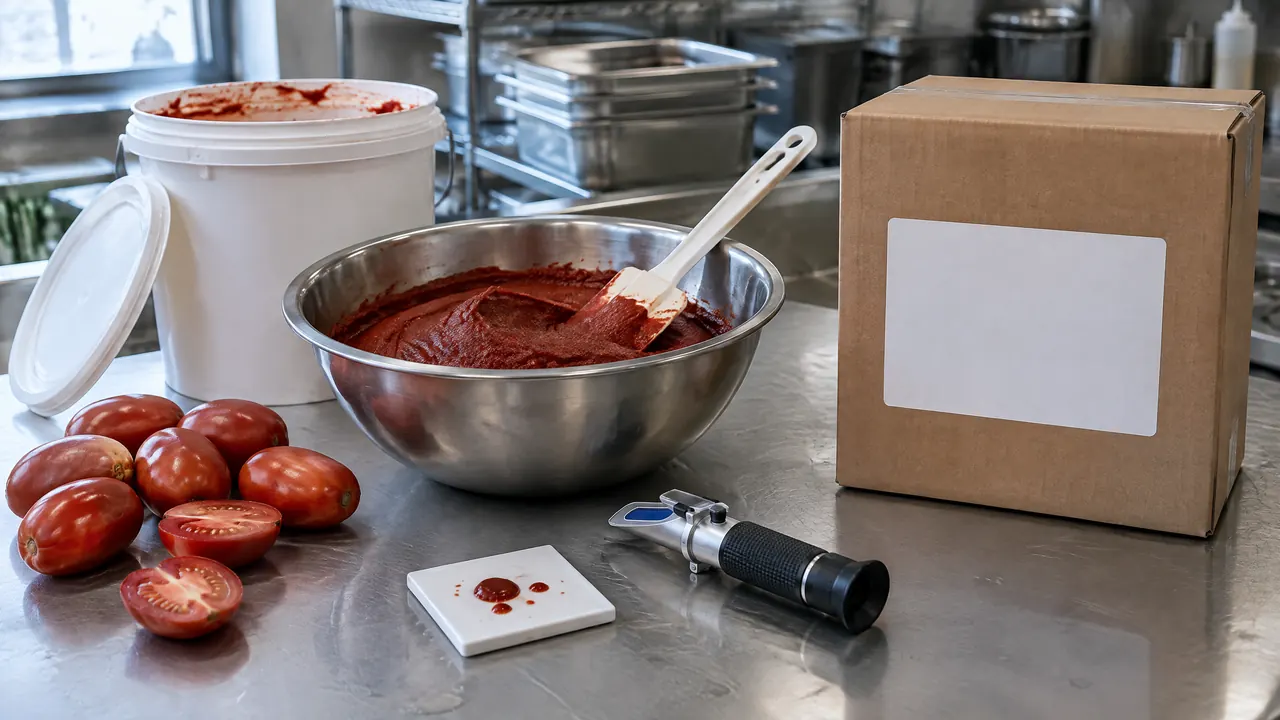
Tomato paste sits quietly behind a lot of QSR menu items: pizza sauce, burger and BBQ sauces, ketchup made in house or by a co-packer, curries, soups and braises. Because it is a concentrate, small differences in strength or thickness flow straight into the finished sauce. A paste that is two Brix points weaker or noticeably thinner can change how a pizza sauce spreads, how a burger sauce clings and how much paste each batch needs.
The 2026 crop in numbers
The World Processing Tomato Council's 9 October 2026 update estimates global processing tomato production at 39.1 million tonnes, after an upward revision for California. That compares with about 40.4 million tonnes processed in 2025. Final figures are due at the 2026 Tomato Conference in Parma on 28 October.
- California. USDA's August forecast was 10.0 million short tons (about 9.07 million tonnes), 10% below 2025's contracted production of 11.1 million short tons, from 182,000 contracted acres. USDA noted a third year of lower contracted acreage as processors balance inventory with demand. The council's 9 October update then lifted the California estimate to about 10.3 million short tons (9.34 million tonnes). That revision is what moved the global figure to 39.1 million tonnes.
- China. The council's 25 September table puts China at about 5.15 million tonnes for 2026, roughly half the 10.45 million tonnes processed in 2024. The same table puts 2025 at 4.90 million tonnes, so 2026 is a small step up from last year, not from 2024.
- Southern Europe. The 9 October update reports lower Brix in several countries after a hot season. Northern Italy averaged 4.78 Brix at intake, which the council described as very low. Spain's crop is expected at about 2.57 million tonnes against a 2.6 million tonne estimate, and Portugal reported Brix below its historical average.
- Australia and New Zealand. The 25 September table lists Australia at 161,000 tonnes for 2026, about 24% below the 211,000 tonnes of 2025, and New Zealand at about 15,000 tonnes.
A June 2026 Rabobank outlook, reported by FreshFruitPortal, expected inventories to rebuild and demand growth to slow through the 2026-27 season, and warned that tight California acreage could squeeze supply again as the market approaches 2027.
What this means for buyers: the 2026 estimate is a little below 2025, so the update does not describe a global shortage. Lower Brix in parts of Europe, and a smaller Australian crop, are good reasons to check every new season's paste against your specification rather than assuming it matches last year's.
Where Australia's bulk paste comes from
Australia grows only a fraction of the tomato it uses in processed form. The Australian Processing Tomato Research Council's 2025 journal reports 211,011 tonnes delivered in 2024/25, to two processors. Using ABARES data, the same journal shows imports of tomato products in 2024 of 550,857 tonnes in raw tomato equivalent, the highest volume in the series it has published since 2010. For paste and puree in packs over 1.14 litres, the formats foodservice uses, the main sources were the United States (41%), China (39%) and Italy (11%).
Trade policy is also in the news. An anti-dumping and countervailing investigation into prepared or preserved tomatoes from Italy (case 654, covering those tomato products rather than paste) was terminated on 3 February 2026 without duties. The Anti-Dumping Review Panel later asked the commission to reinvestigate certain findings, and a preliminary reinvestigation report was published on 28 September 2026. It is worth watching if your menu also uses those prepared tomatoes. No outcome beyond that report is settled here.
Puree or paste? The definitions
The Codex standard for processed tomato concentrates (CXS 57-1981) sets the international language most factories use:
| Product | Natural total soluble solids | Typical QSR use |
|---|---|---|
| Tomato puree | At least 7% but less than 24% | Soups, braises, lighter sauces |
| Tomato paste | 24% or more | Pizza sauce, ketchup, burger and BBQ sauces, curry bases |
Codex measures those solids on the product without added salt. US rules in 21 CFR 155.191 use the same 24% line for paste but start puree at 8%. Commercial paste is often traded in bands such as 28 to 30 Brix (double concentrate) or 36 to 38 Brix (triple concentrate). Those bands are trading practice, not a Codex or legal standard, so always state the band you want.
What to put in a tomato paste specification
- Brix band. The soluble solids range, measured by refractometer at 20°C, with a tolerance.
- Hot break or cold break. Hot break heats chopped tomatoes quickly to inactivate the enzymes that break down pectin, giving a thicker paste suited to ketchup and sauces that must cling. Cold break uses lower temperatures, which gives a thinner paste with fresher flavour and brighter colour, often preferred for pizza and pasta sauces. A 2002 Journal of Food Science study of hot-break and cold-break tomato juice found differences in viscosity, colour and flavour.
- Consistency. Usually read on a Bostwick consistometer as centimetres of flow in 30 seconds after dilution to a set Brix. A lower number means a thicker product. USDA publishes the method.
- Colour. A colour reading or ratio agreed with the supplier, plus a visual standard.
- Mould count. The Howard mould count is a microscope check for mould filaments that indicates the quality of the fruit used. Agree a maximum. USDA publishes the method.
- pH and acidity, plus any limits on salt or added ingredients. Codex allows salt, spices and aromatic herbs and their natural extracts, lemon juice as an acidulant, and water.
- Micro and contaminants. Commercial sterility for aseptic or canned packs, plus pesticide residue testing against Australian and New Zealand limits. Those test documents belong to the factory. Shiiv Imports holds ISO 9001.
- Pack format. Common options are aseptic bags in drums or bins, bag-in-box and large cans. Match the pack to how fast each store uses it after opening.
- Shelf life and storage, including how long an opened pack can be held chilled.
- Origin and traceability. Country of growing and a lot code that links to harvest records.
Labelling and supply chain checks
Bulk packs sold to food businesses still carry obligations under Standard 1.2.1 of the Food Standards Code. Packaged food sold to a caterer must carry the name of the food, lot identification, date marking, storage directions and any required warnings on the label. The supplier's name and address, and some other information, can travel in documents that accompany the food. If you make your own sauces from paste, keep the specification and allergen declaration on file so you can label the finished sauce correctly.
Origin is also a governance question. The same Rabobank outlook said China was keeping production near 2025 levels, and linked that pullback to closer scrutiny of labour practices, traceability and origin labelling. Businesses with consolidated revenue at or above the threshold in section 5 of the Modern Slavery Act 2018 must report on modern slavery risks. Many chains now ask suppliers for farm-to-lot traceability as part of approval. That request is a buyer check. It is not a finding about any origin.
Our take
Tomato paste is easy to approve on Brix alone, and that is where consistency problems start. In a year with a smaller global crop and lower Brix in parts of Europe, a tight specification, a kitchen trial and clear origin documentation do more to protect your sauces than changing drums without a trial.
QSR Supplier sources tomato purees and pastes, sauces and condiments to a buyer's brief, in bulk foodservice packs when the brief calls for them. See our sauces and condiments supplier page, the guides to allergen labelling for QSR sauces and burger pickles and sliced gherkins, what we source and our trade catalogues. To set one tomato paste specification across your stores, send a chain brief or talk to our team.
Frequently asked questions
What is the difference between tomato puree and tomato paste?
Under the Codex standard, tomato puree has at least 7% but less than 24% natural total soluble solids, and tomato paste has 24% or more. Those solids are measured without added salt. Paste is stronger and thicker, so recipes need less of it. Always state the Brix band you want in the specification.
What Brix tomato paste should a QSR use?
Many foodservice kitchens use double concentrate at about 28 to 30 Brix, and some sauce makers use triple concentrate at 36 to 38 Brix. Those are common trading bands, not a legal standard. The right band depends on your recipe and dilution. Fix it in the specification and adjust recipes if you change bands.
Is hot break or cold break paste better for pizza sauce?
Cold break paste is often preferred for pizza and pasta sauces because it keeps a fresher flavour and brighter colour. Hot break paste is thicker and suits ketchup, burger sauces and BBQ sauces that need body. A 2002 Journal of Food Science study of hot-break and cold-break tomato juice found differences in viscosity, colour and flavour. Trial both against your recipe before you approve one.
Where does Australia's bulk tomato paste come from?
ABARES import data published by the Australian Processing Tomato Research Council shows that, in 2024, paste and puree in packs over 1.14 litres came mainly from the United States (41%), China (39%) and Italy (11%). Australia's own processing crop is estimated at about 161,000 tonnes in 2026 by the World Processing Tomato Council.
Will tomato paste be in short supply in 2026-27?
The World Processing Tomato Council estimates the 2026 global crop at 39.1 million tonnes, a little below the 40.4 million tonnes processed in 2025. A June 2026 Rabobank outlook expected inventories to rebuild through 2026-27. The update does not describe a global shortage, but tight California acreage could tighten the market again heading into 2027.
What should a QSR ask a tomato paste supplier for?
Ask for a full specification covering Brix, hot or cold break, Bostwick consistency, colour, mould count, pH, micro and residue testing, pack format and shelf life, plus a certificate of analysis for each lot, the country where the tomatoes were grown, and lot-level traceability back to harvest. Factory food-safety documents belong to the factory. Shiiv Imports holds ISO 9001.
Sources
- Tomato News, WPTC crop update as of 9 October 2026
- World Processing Tomato Council, world production estimate as of 25 September 2026
- Tomato News, WPTC world production estimate as of 7 June 2026
- USDA, California processing tomato report, 28 August 2026
- FreshFruitPortal, Rabobank processed tomato outlook, 29 June 2026
- Australian Processing Tomato Research Council, 2025 journal
- Codex Alimentarius, Standard for Processed Tomato Concentrates, CXS 57-1981
- US Code of Federal Regulations, 21 CFR 155.191 Tomato concentrates
- Journal of Food Science (2002), flavour, viscosity and colour of hot and cold break tomato juices
- USDA Agricultural Marketing Service, consistency of tomato products (Bostwick method)
- USDA Agricultural Marketing Service, Howard mould count for tomato products
- Standard 1.2.1 Requirements to have labels or otherwise provide information
- Modern Slavery Act 2018 (Cth), section 5
- Australian trade remedies public record, case 654
This guide summarises public industry, research, regulator and government information current at 20 October 2026. Crop figures are estimates and forecasts that can change, and the council's final 2026 figures are due on 28 October. The 28 to 30 and 36 to 38 Brix bands are common trading bands, not a legal standard. It is general information, not legal, food safety or trade advice. Confirm requirements with FSANZ, your state or territory food regulator, your food safety adviser and your suppliers.